We have all been there. You are merging onto the highway, preparing to change lanes. You check your rearview mirror, check your side mirror, and then go to perform the crucial “shoulder check” to clear your blind spot. But as you turn your head, you hit a wall of stiffness and pain. You physically cannot turn your head far enough without twisting your entire upper body—a move that inadvertently pulls your hands on the steering wheel and causes the car to swerve.
This is a frightening scenario, yet it is an increasingly common reality for many drivers.
While we often associate flexibility with athletes or yoga practitioners, Range of Motion (ROM)—specifically in the neck and shoulders—is a critical component of driving safety. When that range is limited, your reaction times slow down, your field of vision narrows, and simple maneuvers become hazardous.
If you are finding it difficult to check your blind spot, it is not just a nuisance; it is a safety warning. Here is why your neck mobility matters, why it might be restricted, and how you can reclaim your full range of motion.
Understanding Range of Motion and Driving Safety
Range of Motion refers to the full movement potential of a joint, usually its range of flexion and extension. When it comes to driving, the cervical spine (your neck) is the MVP. To safely check a blind spot, a driver typically needs to rotate their neck approximately 70 to 80 degrees to the left or right.
However, many adults suffer from restricted cervical rotation, often capping out at 50 degrees or less. When your neck cannot rotate sufficiently, your brain forces your body to compensate. You might pivot your torso, lean forward excessively, or rely solely on your mirrors—leaving a dangerous gap in your visual awareness.
Maintaining an optimal Range of Motion ensures that you can:
- Scan intersections quickly: You need to look left, right, and left again without hesitation.
- Park effectively: Reversing requires significant neck rotation.
- Drive comfortably: Chronic stiffness leads to driver fatigue, making you less alert on long trips.
The Root Causes of Limited Neck Mobility
Why does the neck stiffen up in the first place? While age plays a role in joint flexibility, it is rarely the sole culprit. Often, limited Range of Motion is the result of lifestyle factors and untreated muscular imbalances.
The “Tech Neck” Epidemic
In our modern world, we spend hours hunched over smartphones and laptops. This forward-head posture places immense strain on the cervical spine. Over time, the muscles at the back of the neck (like the trapezius) become chronically tight and shortened, while the deep neck flexors in the front become weak. This imbalance acts like a parking brake on your neck’s ability to rotate.
Past Trauma and Micro-Injuries
You do not need to have been in a major car accident to suffer from trauma-based stiffness. Old sports injuries, minor whiplash from years ago, or even repetitive strain from sleeping in an awkward position can create scar tissue. This scar tissue reduces the elasticity of the muscles and ligaments, physically restricting how far the joint can move.
Muscle Inhibition
Sometimes, a muscle is not just tight; it has effectively “shut down.” When a muscle is overworked or injured, the brain may deactivate it to prevent further damage—a phenomenon known as muscle inhibition. When prime mover muscles are inhibited, surrounding muscles must work overtime to stabilize the head. These overworking muscles become rigid and painful, severely limiting your ability to look over your shoulder.
Exercises to Improve Range of Motion
Before relying on mirrors to do the work for you, try incorporating gentle stretching and mobility exercises into your daily routine. These can help lubricate the joints and lengthen tight tissues.
Note: Always move slowly and never push through sharp pain. If you experience dizziness or numbness, stop immediately.
1. The Seated Cervical Rotation
Sit up tall with your shoulders relaxed away from your ears. Slowly turn your head to the right as far as you comfortably can, aiming to look over your shoulder. Hold for 10–15 seconds. Return to the center and repeat on the left side. This directly mimics the blind spot check.
2. Upper Trapezius Stretch
Sit on one hand to anchor your shoulder down. Tilt your ear toward the opposite shoulder (e.g., right ear to right shoulder) until you feel a gentle stretch along the side of your neck. To deepen the stretch, gently place your free hand on your head and apply the weight of your hand—do not pull.
3. Chin Tucks
To counteract forward head posture, perform chin tucks. While looking straight ahead, draw your chin straight back as if you are making a “double chin.” You should feel a lengthening sensation at the base of your skull. Hold for 5 seconds and release.
4. Doorway Pec Stretch
Tight chest muscles often pull the shoulders forward, which indirectly restricts neck movement. Stand in a doorway with your forearms resting on the doorframe at shoulder height. Gently step one foot forward until you feel a stretch across your chest.
Reclaiming Mobility with Straight Up Health & Wellness
While stretching is beneficial for maintenance, it often fails to address the underlying mechanical or neurological issues causing the restriction. If you have been stretching for weeks with no improvement, or if your stiffness is accompanied by pain, professional intervention is necessary.
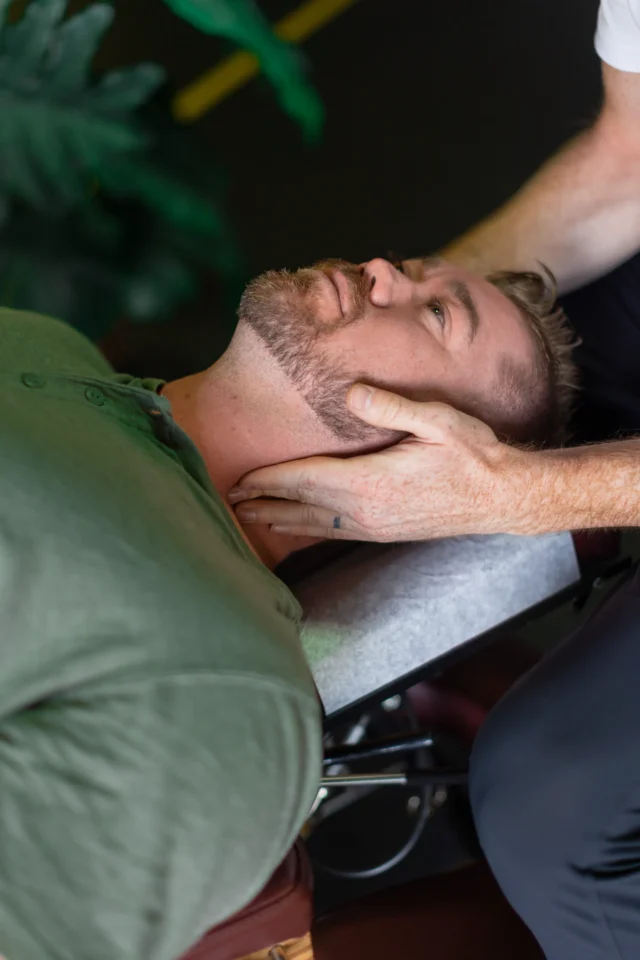
At Straight Up Health & Wellness in St. George, UT, we take a different approach to stiffness. Dr. Gavin Hall—founder and specialist—understands that restoring Range of Motion requires more than a generic “crack and come back” adjustment. It requires a full-body investigation into why the restriction exists.
We utilize specialized, cutting-edge techniques to restore function to the neck and shoulders:
Advanced Muscle Integration Technique (AMIT)
Dr. Hall is one of only two practitioners in Southern Utah trained in AMIT. This revolutionary therapy identifies muscles that have been inhibited due to stress or injury. By reactivating these muscles, we restore their ability to contract and support the joint. Once the primary muscles are firing correctly, the surrounding muscles can relax, instantly improving your Range of Motion and reducing pain.
Neural Pathway Integration (NPI)
Sometimes the issue is in the connection between the brain and the body. NPI is a gentle, non-invasive technique that corrects neurological inhibitions. By clearing these pathways, Dr. Hall can reset the body’s tension patterns, allowing for fluid, pain-free movement. Dr. Hall is currently the only chiropractor in the area certified in this technique.
Full-Body Adjustments
The neck does not operate in a vacuum. A misalignment in the thoracic spine (upper back) or even the hips can cause compensatory stiffness in the neck. Our comprehensive, full-body care ensures that every joint is aligned, promoting long-term healing rather than temporary relief.
Conclusion
Driving is a complex activity that demands your full physical capabilities. If you are unable to check your blind spot without discomfort, you are driving with a handicap that puts you and others at risk.
You do not have to accept stiffness as a natural part of aging or a consequence of office work. By addressing the root causes of limited Range of Motion—whether through daily mobility work or specialized treatments like AMIT and NPI—you can regain the freedom to move.
Don’t let pain hold you back. Take the first step toward safer driving and a pain-free life by scheduling an appointment with Straight Up Health & Wellness today.